
Low-Voltage RGB vs High-Brightness RGB Honeycomb Lighting
Published 2026-09-22
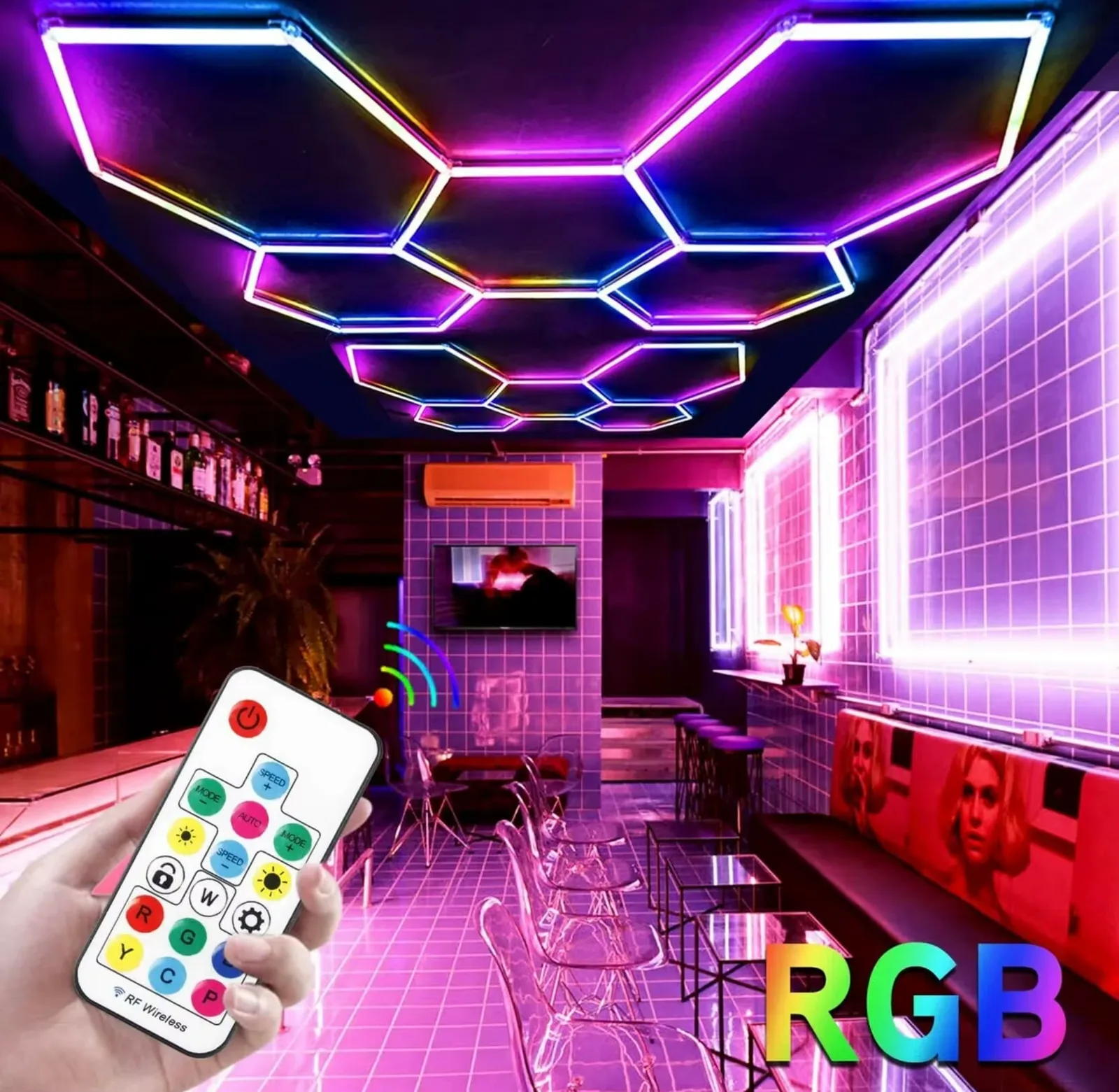
Both RGB families are built from the same modular principle and both are quoted by configuration. The decision between them is an electrical one: the low-voltage family runs from separate DC power supplies, while the high-brightness family runs from mains AC. Everything else follows from that.
The two families side by side
| Low-Voltage RGB | High-Brightness RGB | |
|---|---|---|
| Supply | DC24V directional, DC5V non-directional | AC85 to 265 V |
| LED | SMD2835 directional, SMD5050 non-directional | SMD2835 |
| Colour | RGB | RGB |
| CRI | Not stated | 80 |
| Light face | Not stated | 22 mm |
| Configurations | 5-Hex / 11-Hex / 14-Hex / 14-Hex + Frame | 1-Hex to 15-Hex, plus framed |
The CRI and light-face rows are empty for the low-voltage family on purpose. We state those figures only where they are documented for the product, and they are not part of the specification we can currently declare for that family. An empty cell is more useful to you than a filled one nobody can stand behind.
What the DC supply means on site
A low-voltage system needs power supplies, and the quantity of power supplies and remotes is not fixed: it varies with the configuration being installed. That has two practical consequences worth planning for before the ceiling is closed.
- There is somewhere to put the power supply, and it needs to be accessible rather than sealed above a finished ceiling
- The number of supplies and remotes is confirmed against the configuration, so it is a per-project figure rather than a fixed accessory list
- The run from supply to cells is a low-voltage run, which is a different wiring arrangement from a mains-fed ceiling
The AC family carries its own supply per fixture, so the ceiling connects to mains and there are no remote supplies to house. That is the practical reason many retrofits and single-contractor installations end up on the AC side.
Where each one tends to fit
The low-voltage family is a colour system for spaces where the DC arrangement is already part of the plan, or where the design calls for the specific colour behaviour the 5 V non-directional option provides. The high-brightness family is the one to look at when the ceiling has to be fed from mains and the RGB treatment is part of the main lighting rather than an added effect.
We are deliberately not telling you that one is brighter than the other. We do not publish lumen figures for either, so a claim about which produces more light would not be something we could support. The family name describes the intended role in the range, not a measured comparison, and you should treat any supplier statement about output the same way: ask for the figure and the test it came from.
Configuration range is the other half of the decision
The configuration range differs as well. The low-voltage family covers 5-Hex, 11-Hex, 14-Hex and 14-Hex plus frame. The high-brightness family spans 1-Hex to 15-Hex plus framed layouts, so it is the wider of the two and the only one of the pair that can be specified as a single small cell.
That matters on a ceiling where the RGB treatment has to work around beams, doors or a fixed feature, because a wider configuration range gives more ways to fill an awkward area without custom cutting. On a regular ceiling it matters much less.
What to send us
For either family, the useful inputs are the same: the clear ceiling dimensions rather than the room, the number of bays or complete layouts, where the supply can physically be placed, and the destination market. With those, the configuration and the accessory quantity can be quoted rather than estimated.
Can the two families be mixed in one ceiling?
They are separate families with different supply arrangements, so treat a mixed ceiling as a project-specific question rather than assuming the two can share a supply. Send the layout and the answer is confirmed against it.
How many power supplies will I need?
It depends on the configuration, so it is confirmed per project rather than quoted as a fixed number. The quantity of power supplies and remotes varies with the configuration being installed.
Which one is brighter?
We do not publish lumen figures for either family, so we cannot make that comparison and neither should a supplier who cannot show you the figure and the test behind it. The differences we can state are the supply, the LED type, the stated CRI and light face, and the configuration range.
Why is the CRI blank for the low-voltage family?
Because it is not part of the specification we can currently declare for that family. We state CRI where it is documented, which is 80 across the AC range, and leave the field empty rather than filling it in.