
How to Verify a Chinese LED Lighting Factory Before You Order
Published 2026-09-22
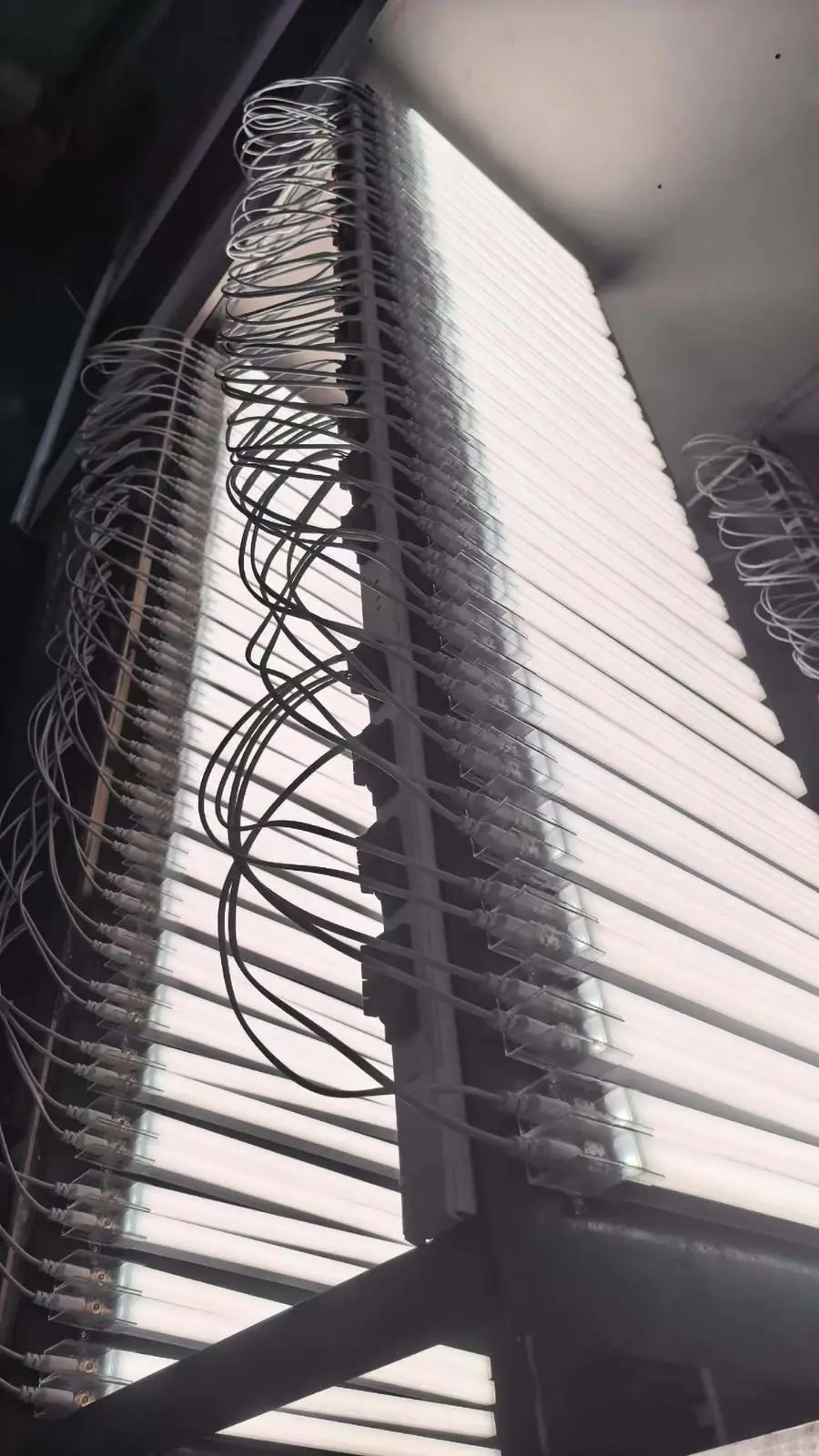
Ask for four things and read the answers: the configuration-to-dimension-and-power table, the reason the configuration sequence has gaps, the component list with lengths, and the voltage rating in writing. A manufacturer answers all four from its own line. A reseller forwards the question and returns a brochure.
Start with the specification table, not the brochure
A modular system is quoted by configuration, so the first thing worth asking for is the mapping from configuration to overall dimension to power. Anyone selling this product should be able to produce that table without going away to check.
This is what ours looks like, and it is the shape your supplier table should have:
| Configuration | Overall size | Power |
|---|---|---|
| 1 grid | 987 x 987 mm | 46 W |
| 11-Hex | 2315 x 3200 mm | 276 W |
| 14-Hex | 4070 x 2390 mm | 458 W |
| 14-Hex + Frame | 2410 x 4795 mm | 600 W |
Two things to look for in the answer. First, whether the sizes are overall dimensions of the finished layout rather than of an individual fitting, because the second number is useless for fitting a ceiling. Second, whether the supplier volunteers the caveat that one footprint can carry more than one rating. Ours does: the 4070 x 2390 mm size appears at both 458 W and 520 W depending on the variant, and the 2410 x 4780 mm frame carries a band of ratings from about 360 W to 632 W depending on how the cells are arranged inside it. A supplier who names the variant is being straight with you. A supplier who quotes a bare number for a footprint, and cannot say which variant it belongs to, has not understood the product.
Ask why the configuration sequence has gaps
Our range runs through 1, 2, 3, 4, 5, 6, 7, 8, 11 and 14 hole configurations. The sequence is deliberately not continuous: it jumps from 8 to 11, because the intermediate counts do not assemble cleanly from the standard tube lengths and connectors, and reaching them would mean introducing custom-cut parts.
This question is a useful test because it cannot be answered by reading a catalogue. The correct answer is mechanical: it describes a constraint in the tube and connector system. If a supplier offers you a 9 or 10 grid without explaining what changes in the assembly, they are either custom-cutting it without telling you or they are reprinting someone else numbers. Either way you want to know before you place the order, not after.
Ask for the component list, with lengths
The parts decide whether a layout can be extended later, and whether a replacement tube two years from now will fit. Ask for the tube lengths and the connector types by name. Our list is short and specific: PC tubes at 440, 570 and 1175 mm, aluminium tubes at 440 and 1175 mm, RGB tubes at 410 and 1210 mm, and ten connector types covering V, I, L, Y, T, Cross, V60, E60, X and Snow.
A supplier who cannot list the connector types is not assembling the product. If the answer is a general statement about being compatible with everything, ask for the drawing of one connection instead, including how the pins are protected. The arrangement is the difference between a system that can be maintained and one that has to be replaced.
Ask for the voltage rating in writing
Voltage is where market wording and product rating get confused, and it is worth separating the two before you order. A listing described as a 110 V or 220 V car wash light is usually describing the market the seller expects to ship into, not a rating that has been declared for the product.
Our AC product lines are stated as AC85 to 265 V, which spans both common market voltages, and the low-voltage RGB kits keep their genuine DC ratings of DC24V and DC5V. Ask your supplier to state the rating for the exact item you are buying, in writing, on the quotation. A rating that only exists in a chat message is not a specification.
Ask what the sample is, and what it costs
A sample is where a supplier either demonstrates the finish and the connector fit or reveals that they have never touched the product. Ask two questions: can sampling start below the production minimum, and what exactly will the sample be built to.
The production minimum is 10 pieces. If a sample is part of the agreed process, confirm its specification against the ceiling dimensions before proceeding; a sample based on guessed dimensions may not match the eventual layout.
Ask which documents apply to your destination
Compliance documentation should be checked per product and destination, not assumed from a list of logos. Ask which document applies to the exact product being quoted and verify it before ordering.
The questions a trading company does not have an answer for
- What is the overall dimension and power of this exact configuration, as opposed to the cell size?
- Why does the configuration count skip from 8 to 11?
- List the connector types and tube lengths in the family.
- What is the declared voltage rating for the item being quoted?
- Can sampling start below the production minimum?
- Which documents apply to this product in my destination market?
- Can I have the drawing that the production and inspection stages are checked against?
None of these require a factory visit. All of them require someone who knows the product, and the answers either arrive in the first reply or they do not arrive at all.
Keep configuration-dependent figures specific
Where a figure depends on the configuration, ask for the value attached to the exact item being quoted instead of accepting a number copied from a different variant.
Do I need to visit the factory to verify it?
No. The specification questions above are answered in writing by a manufacturer and are much harder to fake than a factory photograph. A visit is useful once you have shortlisted, and much less useful as a first filter.
What is the single most reliable check?
Ask why the configuration sequence jumps from 8 to 11. It is a mechanical constraint in the tube and connector system, so the answer cannot be produced from a catalogue, and an unanswerable question tells you more than a correct answer to an easy one.
How should I check compliance documents?
Ask which document applies to the exact product and destination, then verify that document before ordering rather than assuming a logo applies to every variant.
How do I check the voltage for my market?
Ask for the declared rating of the exact item being quoted, in writing. Our AC lines are stated as AC85 to 265 V, and the low-voltage RGB kits are DC24V or DC5V. A market label such as 110 V or 220 V on a listing is not the same thing as a declared rating.
If you want to run these checks against a live project, send the ceiling dimensions, the destination market and the standard you need to meet through the request form, and the answers come back with the layout.